Showing posts with label module progress. Show all posts

Monday, July 21, 2014

Shelf Rot

It's only been 18 months since my last update about/or any work done on the WP 3rd street freight house model. On a geologic time scale, I'm blazing along with blinding speed!

The time spent on the shelf of my cluttered office/man-cave/workshop has taken its toll on the model though. Specifically the delicate handrails on the stairs and deck that lead to the office doors. One wouldn't have needed to be Nostradamus (1503-1566) to predict that any such wear and tear would have worn and torn in that particular area. And since this model is intended for a module (a drop-in module at that) the decision to fabricate the handrails in ultra small diameter plastic rod was probably pure folly from the start.

So I've broken my R Street modeling fast by attending to rebuilding the handrails, this time in brass. My soldering skills are merely at the neophyte level, so it took me longer then most modelers to fiddle, tack and solder all the brass together and then bend it where needed and then clip and file away the excess solder till it looked half way decent. Still, it was a fun Sunday evening project to while away the hours until the final episode of the second season Endeavor came on Masterpiece.

I'm hoping it whetted my appetite for more modeling soon. And we can hope this will be 'soon' measured on more of a Julian calendar, something that measures mere weeks rather than epochs and eons.
It's a sad state of affairs... the plastic rod, it's not so strong. 
 
Laying things out. 


Tacked down and ready for solder... 


But maybe not _that_ much solder... 
Eventually it cleaned up somewhat. 

Sunday, January 13, 2013

Freight House: the handrails

Hello, everyone. Just a quick build update as I did manage to deal with the handrails on the freight house model over the weekend.

I certainly don't hold myself out to be a master modeler (and I'm sure you're seeing a multitude of sins in these very close up shots... click the picture to get really close in), but I rather like the way the handrails turned out. I built them up out of .025" Plastruct rod. For your amusement, I've included a number of in progress pictures.


I think I'll install those window A/C units next.

Wednesday, January 9, 2013

Freight Office Model Update

I may have mentioned somewhere that I am a really, really slow modeler. Even after I take into consideration the non-modeling demands on my time, I can only come to the conclusion that my progress on any given modeling project has to be measured on a geologic time scale.

Over the holidays I did manage to put in a few, ok, several hours on the freight office- and I'm still not done with the one wall I've been working on. So here is a picture in the midst of the sausage making .
My plan is to put as many of the details (including paint) while I can still work on the individual walls as separate pieces as  possible - I have other walls cut out and most of the windows installed by the way but I'm still a  long ways from assembling them together.

That said, I did get the foundation piece under the wall (not trimmed completely yet) and I've extended off to the left where the electrical conduit starts. 

The little bits attached to the walkway are the beginnings of  handrails. The steps going up to the walkway took a verrrry long time. I cut stringers from sheet plastic and then used strips to put the steps in and additional strips to fill in the backs of the steps (the rise). I probably could have built it up faster with sheet plastic. I'm not too worried about the little chip off the bottom of the walkway- there will be quite a bit of sculptamold paving on this side of the building when it is put in the drop in module.

Anyway... hopefully there will be another update on this project before the rurn of the next epoch.

Monday, October 15, 2012

Conductor Heads and Downspouts

As the in window air conditioners were obviously not original with the building it is not surprising that there is quite a bit of external electrical conduit on the freight office walls.  But before I can do any modeling of the electrical conduit I need to tackle the noodle at the bottom of the spaghetti: the downspout.

It still amazes me the things I learn on this project. I had to look up what the thingie was that is at the top of the downspout.  It's called a conductor head, or sometimes a leader head and it collects the rainwater, in this case from whatever drainage sloping on the otherwise flat roof, before going down the downspout.

My conductor head is just a shaped chunk of plastic square rod.  I say "just" but it took me several hours before was happy with what you see- or happy enough to stop. I'm not a sculptor, Jim! 

I even hollowed as much out of the top as I dare ---  Hopefully the top of conductor heads were open... I'm not sure if I've ever seen one from the top.  My conductor head is a little bit shorter and squater than the original but I still think it looks good. 

On the original downspout on the offices north wall it empties into a pipe with disappears in the elevated concrete walkway. I managed to find a piece of suitable pipe from my spares that, after a bit of sanding seemed to fit the bill. 

Saturday, October 13, 2012

WP Freight House Details: in window air conditioners

OK, so I'm jumping the gun a little. I'm still cutting plastic for walls and dealing with windows and here I am talking details.

Sorry. Can't help it. Like many of my fellow railroad modelers, I like detail parts.

From Bob Clark's pictures of the freight office in the 1970s in the previous post, we can see quite a few of those in window air conditioners - and evidence that there were more sometime in the past. Sacramento has always had a habit of being really hot in the summer and this was one way to beat it. I've seen earlier pictures of this freight office that showed they used a combination of 1st floor awnings and these little air conditioning units.


So I picked up  this set of BLMA photo-etched (I'm assuming) stainless steel air conditioners from one of the local train shops. They fold up quickly and easily and I think they look really sharp. In one of these pictures you'll see a cast metal air conditioner from my detail part collection of doo-dads that I thought looked good enough at one time... ah progress.

Wednesday, October 10, 2012

Freight House on the Drop In Module

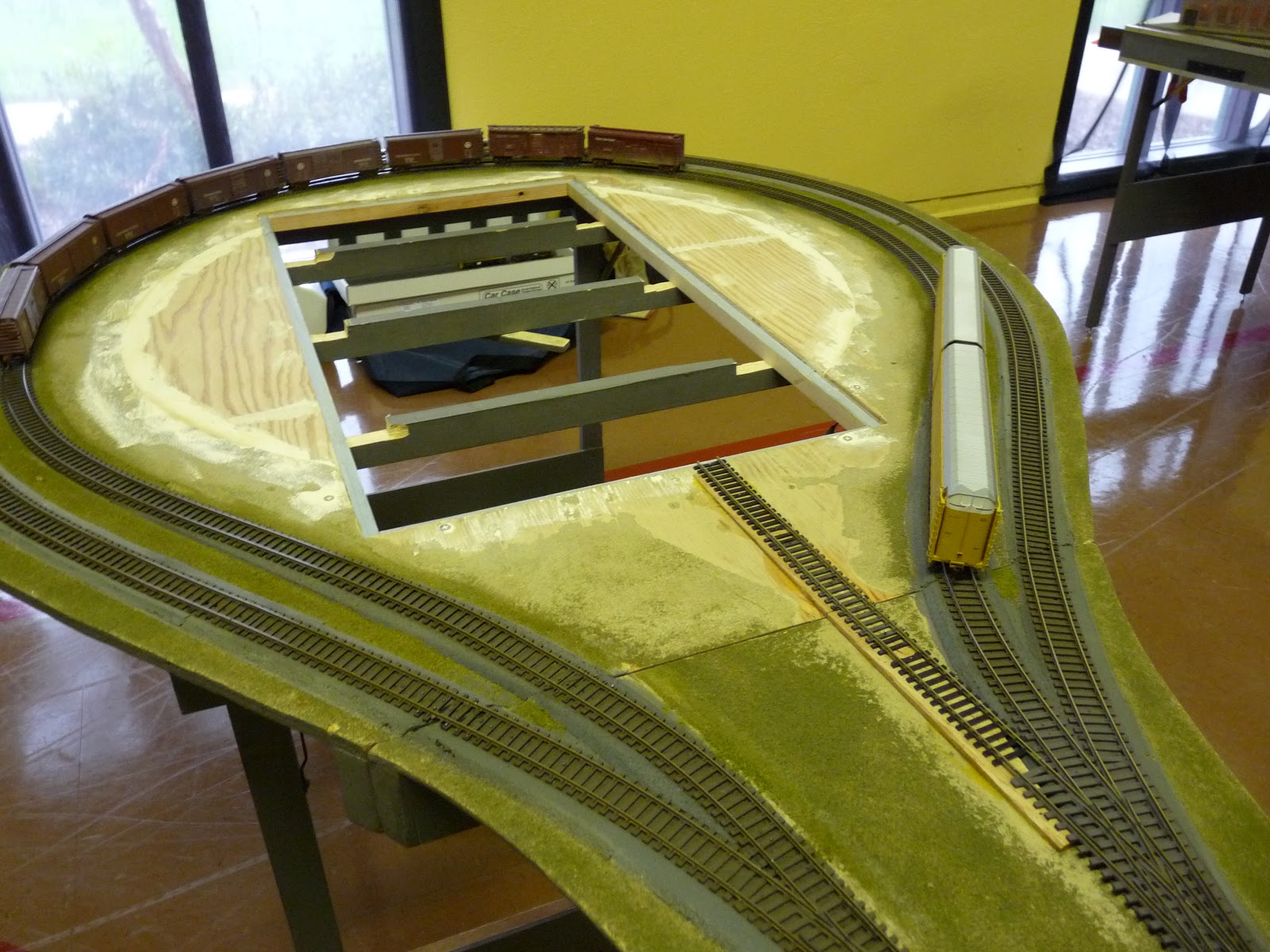
The modular club I belong to (Sacramento Modular Railroaders) is developing a new module type. We're calling these new modules 'drop-ins'.  The club owns two turn loops that have had open centers since they were built several years ago. The idea of the drop-ins is to fill those holes and also to provide the opportunity to construct mini modules that provide additional switching possibilities for our ops sessions.

They will be smallish at 18" wide by 32" long - with a single track centered on line 7" from one edge.

I'm a big fan of this new module type. Their small size means it can fit in the trunk of my car and I can quickly jump to the thing I like most about model railroading - building buildings.  I'm  scratch-building a freight house for my drop-in and it is based closely on the WP freight house that used to be at 3rd and R streets. I've written about this freight house and it's sister at 2nd and R quite a while ago here.

Since that early blog post I've asked and been given permission from Bob Clark to display some of his great pictures he took back in the 1970s of the building. You should be able to double click on the pictures to enlargeify them.

3rd street - West elevation 

freight office north elevation - the truck side
freight office south elevation

further down the south elevation - 

4th street - east elevation. That's the logo of a freight forwarder.

If I did the building in it's entirety, it would measure out to something like 42".  I was not a math major, but I believe that is more inches than I have drop in module length.  So I'm condensing the building - and I'm doing that by only modeling three railroad loading doors instead of the prototype's five. It should still look like a worthy freight house though, and I should be able to just fit it in at just under 32".

So I began cutting plastic and modifying window castings. Here are the first two walls I've been working on.  Wish me luck and the strength to persevere!   
west elevation office wall

north elevation office wall


Thursday, July 7, 2011

T - Minus OMG...

Thank goodness for National Conventions...they have a way of concentrating the mind.

I'm just a few hours away from having to get my module to the National Train Show floor. Then a few hours after the club layout is built I present my clinic on R Street at the NMRA convention.


The module is far from finished... but it is what I call 'presentable'.  Ground cover is in, streets are paved and painted that sort of thing.  That square bit toward the front of the module is my base for what will be the stiff leg derrick.

Wish me luck.

Saturday, April 30, 2011

the latest on Carlaw's

And lest you think that I've just spent my time detailing the Donut Truck...

Here is a picture from the last SMR operations session. I propped up the front wall of Carlaw's against the cardstock mockup.  I'm hoping the edges of the older Carlaw painted sign decal get knocked down some by a coat or two of clear flat that I'm going to spray soon.

Just like the prototype the building the structure is going to be right next to the sidewalk.

Monday, February 14, 2011

Onward.

It has been quite the long pause here on the R Street Layout blog. However, this past weekend was full of forward movement.

I’m happy to say I spent much quality time with my airbrush. I went from knowing where my airbrush was in my shop but otherwise unfamiliar with it, to being able to disassemble and reassemble it with my eyes closed.

Hard to tell from this picture... but those rails are painted.
In fact, there was progress made on several fronts. I painted my track on my 10th and R street module. This is in preparation to paving the streets. I finished some work on the walls of the Carlaw Brothers polishing shed - and put the first primer coat on them. And I started another little project - non R Street related- a detail item for the Sacramento Modular Railroaders. I’ll share more on that if the project turns out ok.

The four walls just prior to the first coat of paint.
What shook me from my hobby slumber you might ask? I was thrice inspired. First off, I saw my name in lights over at the X2011 West National NMRA convention clinic list. As a result, I've become determined to get some modeling done so my talk isn’t entirely history. The next two inspirations were recent arrivals to my mailbox- Tomar Industrie's Stiff Leg Derrick kit and Vector Cut’s Manhole Covers.
Back and side walls with a light coat of paint. 

Front and side walls after a bit of paint. 
I sent away for the derrick kit back in September but it hadn’t arrived. I was going to write it off but my 7 year old son badgered me until I put in a inquiry with Tomar. Much to Tomar’s credit they shipped off the kit with amazing speed after I let them know the first attempt never arrived. The derrick is very much a foreground player on the module, so it is good that my son got on me about it.
Tomar Industries Stiff Leg Derrick Kit.

First man hole cover painted... just waiting for a street to be paved...
I am floored by Vector Cut’s product line. Since the street itself is a major character in the 10th and R module I’m happy there are such things in the world as highly detailed manhole cover parts. I couldn't resist painting one set. While my airbrush was loaded with roof brown for my tracks I put down a base coat on the man hole covers. Later I drybrushed tarnished black on top. This really has me fired up to start paving streets. But first I want to get my sidewalks and curbs done...

Sunday, October 17, 2010

IT .....IS ....ALIVE!

The red light is a good sign. 
But not without a lot of help from friends.

Saturday, October 16th marked the first day the "10th and R Street" module had powered trains cross its four foot self. There were 3, count em, 3 significant wiring errors on my module that were identified and quickly fixed thanks to my friend Dick K. This is why we test the modules during our private ops sessions.  It is much less stressful shorting out the railroad here than in a public show.
Once all the problems were sorted out, the module did quite well  I think . Here is my WP S2 #555 leading the Yolo Rocket on it.
WP 555 on point. 

This test run also showed that I need to file back the rail-ends on the right side (looking at the module from the 'front') a millimeter or so. The fit for the rail connectors on that side was very tight.  Other than that I think I'm set to continue on to scenery.
A Jarring Juxtaposition: the beautiful Coffee Corner module
transitions to the bare 10th and R Street module. 
Speaking of which, I'm having fun with Google Sketch Up's photo matching feature for creating mock ups.  I'm using a 20 MB photo image I purchased from the Center for Sacramento History of the Carlaw Brothers Polishing and Blacksmith shop building. Since I know a couple of key dimensions, it was relatively easy to import the picture and scale it correctly. Then it was just a matter of drawing the building with the picture as a guide. I printed out the four sides in HO scale, glued the printouts to card-stock, cut out the walls and assembled them as a mock up. This was the last mock up I'll build before I cut plastic.  I think this was my third of this building, which has got to be mock up overkill. Whatever, each one has been better than the last.
With buildings that still exist, like the WP Fuller building, photo matching will be even more powerful. I should have pictures of some examples of this soon.

Sunday, October 3, 2010

Progress!

I attended one of the club's work sessions yesterday. With the help of several of my club brothers, to which I'm heartily grateful, I managed to get some critical bits done on the module. Namely: wiring. For me, this is huge. I haven't picked up a hot soldering iron in over twenty years! So it was more than handy to have the massive amounts of experience in the room.  Suddenly, I have a wired module. Some other little odds and ends to the track work were completed as well to the point where it's "operational"- at least it's ready to test that theory. This means I'll be able to have my module included in the club layout for the first time at this month's ops session. Just in time too. After this month, there are a number of public shows and my module is no where near ready for prime time yet- so I would have had to wait for 2011 to test it. And I can't really continue very far with other parts of the module build until I know the track work is OK.  Much of it will be buried in the street (probably using sculptamold) so it would be far less painful to make any adjustments now rather than later.
Note the metal cross pieces- I'm assuming those were there to help combat the expansion and contraction forces with rails embedded in pavement.
Funny that I would be thinking about the prospect of tearing up streets to get to the rails- that's exactly what's happening on the real life R Street right now. The long awaited R Street redevelopment project is kicking into high gear. And they're starting with some infrastructure improvements. If I understand things correctly the rails are going to be retained to keep the industrial flavor (one of the few flavors that does not taste like chicken...) of the street. Reach for the giant Crayola box of imaginary hues and color me "happy" and "pleased". Don't bother trying to stay in the lines.     (Thanks to Dan M for the tip that the street work had started.)

Friday, September 10, 2010

The Carlaw Brothers Granite and Marble Works

Lately my attention has been focused on the Carlaw Brothers buildings since they will be on the front edge of the module I’m building for the Sacramento Modular Railroaders’ layout.

John and Andrew Carlaw, two brothers from Scotland, arrived in Sacramento around 1880 and set up a granite and marble works that took up a quarter block at 10th and R. The business lasted for many decades, long enough to be there during my modeling time-frame.

As I’ve stated before, I’m trying to model things the way they looked in August 1950, but with some of the details for the Carlaw project I may have to fudge a bit. There is photographic evidence that the begging-to-be-modeled crane of theirs was no longer there by January 1950. It was definitely around at least up to 1941 however, so it’s not too much of a fudge.* Perhaps the more serious infraction of the spacetime continuum is presenting Carlaw as a rail served industry in 1950 when photos and railroad documents show their spur was not in use and likely buried or removed by the 1940s . On the other hand, they were listed as a team track customer as late as 1958. I don’t think it’s much of a stretch to pretend that they still had enough rail traffic to justify keeping their delivery track, so I’m forgiving myself for imagineering a Carlaw spur in 1950. Frankly, Carlaw Brothers is just too tempting not to model with an active rail spur.

The Carlaws had their own quarries locally over in Loomis, California at least during the early part of their existence. My guess is that stones from there probably didn’t come by rail but rather hauled by wagons and trucks from fairly early on.** However the Carlaws advertised that they were importers of eastern and Scottish marble and granite. It would seem that these long distance rocks would have to come by rail probably until at least the 40s and maybe into the 50s if they were still importing that late.

Pictures archived at the Center for Sacramento History reveal that the brothers Carlaw had some great buildings to model during this period. The polishing shop, interesting in itself with its old west style false front, had an attached blacksmith shop. This bit of information*** was a particularly cool find for me. I’ve had castings of an HO scale blacksmith, his bellows and forge plus assorted blacksmith tools rattling around my spares drawer for years. The poor guy and his stuff had little hope of ever being used. Now they have a home, and at long last, my pack rattishness has a tangible payoff! Also included in that set is a LED to light up the forge. Should I dare buy a smoke unit for this too? Animation can be like a strong spice, the perfect amount turns an ok dish great- a bit too much and the meal is ruined.
There were also two open sided work-sheds in the compound. The smaller of the two had stout truss frames on the sides and housed a marble saw. The other was quite large, approximately 38 feet by 75 feet and probably protected a number of big stone working tools. Alas, I’m not sure if the big shed will make it on the module though; test fitting my mock ups with it included really crowds the open yard section of the scene.

The only remaining structure still present from that time is a brick building on the corner of 11th and R streets. It was originally built for the Carlaw operation, but I don’t think they used very long. In the 40s and 50s it changed hands a number of times. I plan on modeling it when it housed a beer distributor. The front door is on a short wall that cuts diagonally across the northeast corner and has some decorative brick work that will be fun to model. If I can figure out how to do it, that is.

One find in my digging around on Google was that John Carlaw****, before he came to Sacramento, was involved with quarrying the granite for the Ames Monument.***** This towering edifice was a tribute to the Ames brothers of Union Pacific and the Transcontinental railroad fame and the Crédit Mobilier scandal infamy. When it was built it was sited on the highest elevation on the railroad. Since then, the line moved away from the monument. Now it seems to be in the middle of nowhere.

The Carlaw brothers worked on another monument with railroad connections, the AJ Stevens Monument which is still standing in Plaza Park in downtown Sacramento. They did the stone work for the base.

I’ve been learning a great deal about the stone works industry from many sources, but I’d like to pay special consideration to Peggy and Pat Perazzo’s Quarries and Beyond web-page. The Carlaw project presents a great opportunity to model some of the equipment that was common in stone yards, and their site has been a treasure trove of information towards that end. If I get anything right on the look of the tools, it’ll be because of the Perazzos.

*A picture taken by Eugene Hepting that includes the crane can be seen on page 52 of William Burg’s Sacramento Then and Now.

**There is some evidence that the before the Carlaws arrived, the site itself was used as a stone masons staging ground for work on the capitol. There is also some documentation that shows the Carlaw brothers at least bid on some of the later stone decorating work down on the Capitol and the Capital grounds.

*** Gleaned from a Sanborn Fire Insurance map -- BL. SM. equals blacksmith if you ever see that notation on one of their old maps by the way.

**** The 1880 version of John Carlaw - it appears that “John” was a well used family name through the generations. In the Eugene Hepting scrapbooks (at the Center for Sacramento History) notes that in 1938 the business was run by Jack Carlaw, probably John’s son.

***** History of Laramie County, Wyoming by Jean Bastian page 329.


I’m stealing the * footnote idea from http://gotmedieval.blogspot.com/ - so here’s a shout out to Carl Pyrdum, proprietor of that wonderfully written site.

Friday, February 12, 2010

Module Number One

Modeling may be picking up here at the R Street Project. I've had a mental block when it comes to actual modeling. Tons of research... no modeling. It's sad really.
My current thinking is that by working on modules I’ll get the incentive and momentum I need to get going on the modeling side. Well, my two modules for the Sacramento Modular Railroaders (SMR) are now in my possession.
In the SMR, the 'bones' of the module are built together as a club during our work sessions. This is done to ensure a close fit between modules owned by different members. If the bench work and wiring are all made in a consistent fashion, it goes a long way to proper track alignment. The layout sets up quicker, the trains derail less often- and these are all very good things.  With a bite sized project in front of me I'm very inspired to get going.


Here’s a sketchup pic of what I'm thinking of for the first module.  It's all very 'work in progress' at this point. The track setup is very simple - on purpose. Mostly because it's my first module. Besides, I really want to get to the buildings. The locomotive is too new for my time-frame, but it does give a sense of scale.   And the club does run lots of modern trains after all.

The inspiration is the area around 10th and R Streets. The big brick building against the backdrop is the WP Fuller & Company warehouse. They sold paint, doors and sashes. Currently the building is home to one of my favorite places for breakfast, The Fox & Goose Pub.  

To the right of Fuller is Gillmore's market. In reality this building is on the other side of the alley track from Fuller but it didn't fit there so well on the module. Gillmore's was a butcher shop. Actually there were two businesses on the ground floor, a butcher shop and a beauty salon. This is one of those things I love about prototype modeling - there is no way in heck I would have come up with that juxtaposition on my own. Gillmore's is a nice representative of many midtown Sacramento buildings, retail on the ground floor, residential on the second floor.  Marquis Gillmore, by the way was in his 80s in 1950 and still a few years from retirement. This building is still standing- currently home to a noodle and fortune cookie factory.
In the foreground on the module will be the Carlaw Brothers Stone Cutters. If memory serves, these were two Scotsmen whose business was in this location for quite some time. There is some speculation that the pre-Carlaw, the site was used as stone staging for construction of the capitol building - the stones having been brought to this location from Folsom.  Nowadays it’s a parking lot.

Because I'm having to work around modular standards, I'm moving buildings around and spinning them from their original locations to make everything fit.  Fuller indeed was served by the WP from their alley line but also faced R Street. Fuller's warehouse is too big to fit between the club's mainline and the branch line so I've moved this building back against the backdrop and spun it. The middle row of buildings is all speculation at the moment, but I want to convey the feeling of R street on the foreground and the alley line in the background. I can’t really keep this area an open field and get that feeling. I think I'll use several buildings from other parts of R Street to fill this area. There were a number of small automotive service businesses and small scale electronic supply warehouses that should work in this location and not look too out of place.